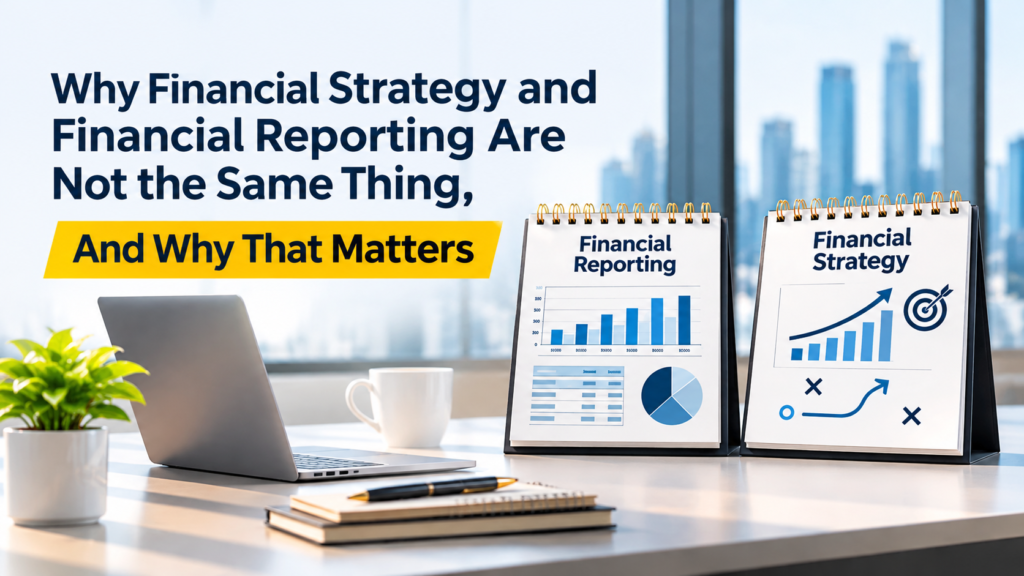

Ask a business owner whether they have a handle on their finances, and many will point to a folder. Monthly reports. A P&L. A balance sheet. Everything neatly filed.
That’s reporting. And reporting is good. But it isn’t the same as having a financial strategy, and mixing the two up is one of the quietest mistakes a growing business can make.
One tells you where you’ve been. The other decides where you’re going. A business needs both, and most only have the first.
What Financial Reporting Actually Does
Financial reporting records and summarizes what has already happened. It turns thousands of transactions into a handful of statements: profit and loss, balance sheet, cash flow.
It does a few essential jobs:
- Shows performance. Revenue, costs, and profit for a given period.
- Supports compliance. VAT returns, Corporate Tax filings, and audits all draw on accurate reports.
- Satisfies outside parties. Banks, investors, and regulators expect reliable numbers.
- Creates a record. A clean history to compare against, month after month.
None of this is optional. Reliable monthly financial reporting services in UAE businesses depend on are the foundation for everything else. Without trustworthy numbers, no strategy can stand.
But look at what reporting can’t do. It can tell you margin fell by two points last quarter. It can’t tell you whether to raise prices, cut a product, or change suppliers. It describes. It doesn’t decide.
What Financial Strategy Actually Does
Financial strategy looks forward. It uses the numbers to answer harder questions:
- Where should the business invest next?
- How much risk can we afford to take?
- When should we hire, expand, or hold back?
- How do we fund growth without running short of cash?
- What happens to us if a major client pays late, or costs jump 10 percent?
A strategy sets direction, weighs trade-offs, and builds in flexibility. It treats money as a tool for reaching goals, not just a record of activity.
Put simply, reporting is the rearview mirror. Strategy is the windscreen and the steering wheel.
The Gap Most Businesses Don’t Notice
Here’s where it gets tricky. Reporting and strategy use the same numbers, so they can feel like one thing. A monthly report lands in the inbox, someone reads it, and it seems like the business is “on top of its finances.”
But a report only becomes useful for strategy when someone asks what it means and what to do next. Without that step, reports pile up. The owner stays informed but not guided.
A quick test shows the difference:
| Financial reporting | Financial strategy | |
| Looks at | The past | The future |
| Asks | What happened? | What should we do? |
| Output | Statements and numbers | Decisions and plans |
| Rhythm | Fixed, scheduled | Ongoing, flexible |
| Owner | Accountant or bookkeeper | Senior financial leadership |
Most SMEs have the left column covered. The right column is where the gap sits.
Why the Difference Matters
This isn’t a matter of vocabulary. Confusing the two has real consequences.
- Decisions get made on instinct. Reports show the numbers, but nobody connects them to the choice in front of the owner. So hiring, pricing, and expansion calls rely on feel.
- Problems show up late. A report tells you cash is tight after it’s tight. A strategy, backed by a forecast, shows the squeeze weeks in advance.
- Effort gets wasted. Teams spend hours producing reports that nobody uses to change anything. The work is accurate, but it doesn’t move the business.
- Growth outpaces control. As a business scales, the number of decisions rises. Reporting alone can’t keep pace with that.
- Opportunities slip. A good deal appears, and the owner can’t say quickly whether the business can afford it. By the time the numbers are checked, the window has closed.
A Short Example
Picture a Dubai trading company turning over AED 8 million a year. Its accountant sends a clean report every month. The books are accurate and the VAT is on time.
Over three months, the report shows gross margin slipping slightly. Nobody comments, because the report doesn’t flag it as a problem. By the fourth month, margin has dropped enough to wipe out most of the profit on a key product line.
Now picture the same business with strategic oversight layered on top. The same margin dip appears in month one. This time, someone asks why. The answer: a supplier raised prices, and the company hasn’t passed the increase on. A quick decision to adjust pricing on two products fixes it before it becomes costly.
The numbers were identical in both cases. The difference was whether anyone was turning them into a decision.
What Good Reporting Looks Like, So Strategy Can Work
For strategy to work, reporting has to be solid first. Good monthly financial reporting services in UAE settings usually share a few traits:
- Timely. Reports arrive within days of month-end, not weeks.
- Accurate and reconciled. Figures match bank statements and the accounting system.
- Clear. An owner can understand the key points in minutes.
- Consistent. The format stays stable, so trends are easy to spot.
- Connected. VAT and Corporate Tax positions draw from the same clean data.
When reporting is fast and trustworthy, strategy has something solid to stand on. When it’s late or messy, even the best strategic thinking is working from a shaky base.
Where Strategy Comes In
Once reporting is reliable, the strategic layer adds the thinking. In practice, that usually includes:
- A rolling forecast, updated regularly, instead of a single annual budget
- Scenario planning, so you know the impact of a late payment or cost spike before it happens
- A framework for big decisions, like hiring, expansion, and borrowing
- Regular reviews that turn each month’s numbers into a short list of actions
- Tax and compliance planning built into the same view, not handled separately
This is the work senior finance people do. It doesn’t need to be constant or heavy. It needs to be consistent and tied to what the business is trying to achieve.
How Often Should Reporting Happen?
Timing matters more than most owners expect. An annual report is useful for the tax office. It’s too slow for running a business.
Monthly is the sensible rhythm for most SMEs. It’s frequent enough to catch a trend early, and spaced enough that the numbers have settled. This is why many growing companies turn to monthly financial reporting services in UAE providers rather than relying on a once-a-year summary. A fast-moving business, such as a trading or e-commerce company, may also want a short weekly snapshot of cash and sales alongside the full monthly pack.
The point isn’t more paperwork. It’s a steady beat of information that strategy can respond to.
Closing the Gap Without Building a Big Team
Many SME owners assume that covering both reporting and strategy means hiring a full finance department. It doesn’t have to.
For most growing businesses, there are two practical routes:
- Bring in senior support on a scaled basis. Virtual CFO services in UAE give businesses access to CFO-level thinking for the hours they actually need, working alongside the existing accountant instead of replacing them.
- Hand over the finance function in stages. Some businesses choose to outsource finance function in UAE settings, starting with reporting and compliance, then adding forecasting and strategic input once the foundation is stable.
Either route avoids the fixed cost of a large in-house team while still closing the gap. The right choice depends on the size of the business, the complexity of its operations, and how much of the work the current team can handle well.
In both cases, dependable monthly financial reporting services in UAE businesses can trust tend to come first. Once the reports are on time and reconciled, adding forecasting and advice on top is a much smaller step.
A Simple Self-Check
If you’re not sure where your business stands, a few honest questions can help:
- Do your reports arrive within a week of month-end?
- Did a report change a decision you made in the last quarter?
- Can someone show you a cash forecast for the next three months?
- When margin or cash moves, do you learn why, or just that it moved?
- Is anyone responsible for turning the numbers into recommendations?
If most answers are no, the business probably has reporting but not strategy. That’s fixable, and the sooner it’s addressed, the more it helps.
The Takeaway
Financial reporting and financial strategy are partners, not substitutes. Reporting gives you the facts. Strategy gives you the direction. A business with only reporting is well informed but poorly guided. A business with only strategy, without reliable numbers, is guessing with confidence.
The strongest finance functions treat the two as one connected loop: accurate reports feed sharper decisions, and sharper decisions shape what gets measured next.
If your business has a stack of reports but still makes major calls on instinct, that’s the signal. The numbers aren’t the problem. What’s missing is the step that turns them into a plan.
Start by checking that your monthly financial reporting services in UAE are timely and reconciled. Then ask who is turning each month’s pack into a decision. If the honest answer is “nobody,” that’s the gap worth closing first.
This article is written from the perspective of Virtual CFO, a UAE-based Virtual CFO and financial advisory firm helping SMEs build reliable financial reporting, cash flow forecasting, and Corporate Tax and VAT compliance systems.